7.7 KiB





Webhook Catcher
The easiest way to capture and debug webhooks in production and development.
A developer-friendly webhook debugging tool — ideal for testing GitHub/Stripe events, bot integrations, or any webhook-based workflow.
Replay, filter, and forward webhooks in real time with zero config.
Features
- Capture and view incoming webhooks in real time
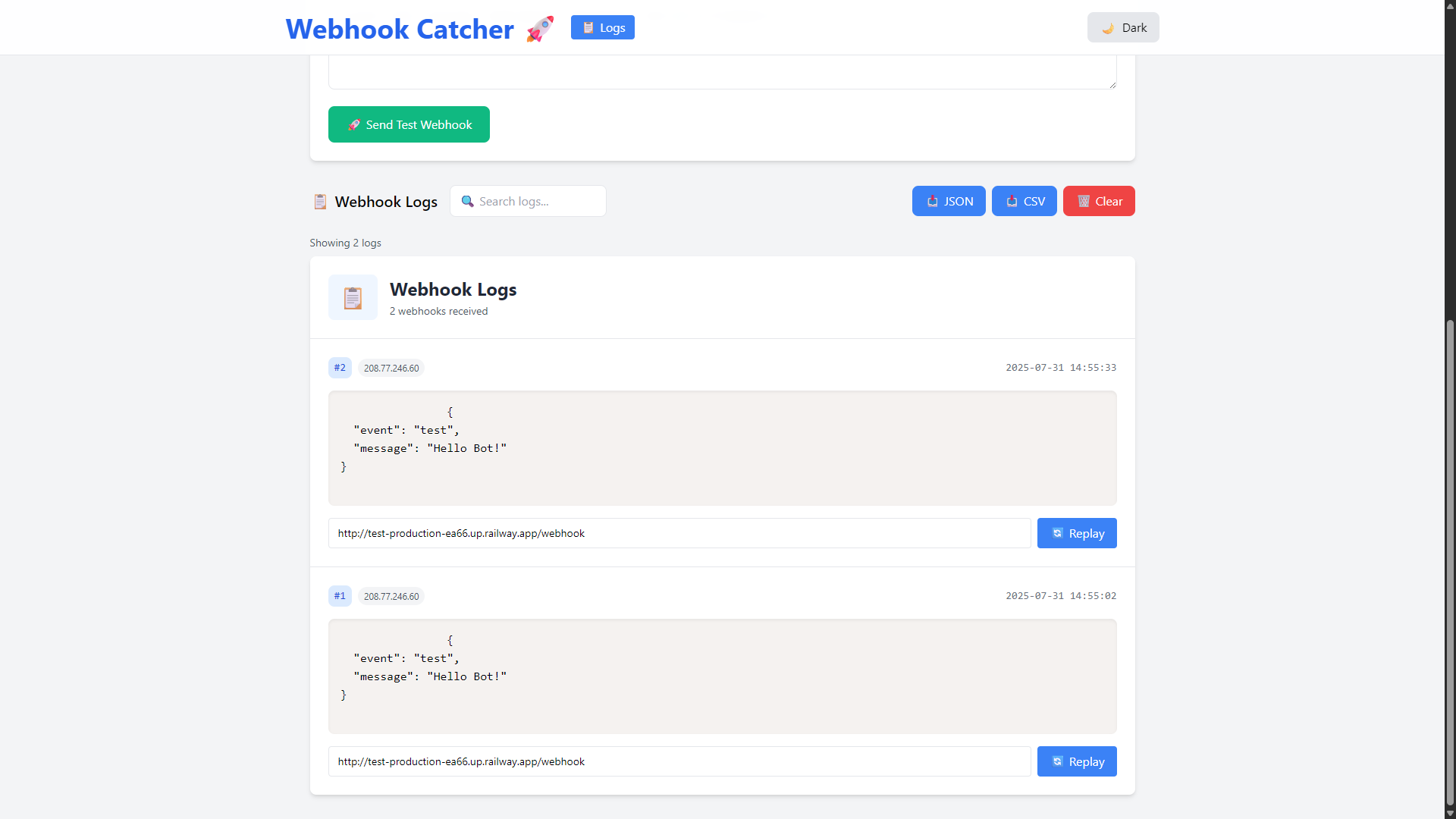
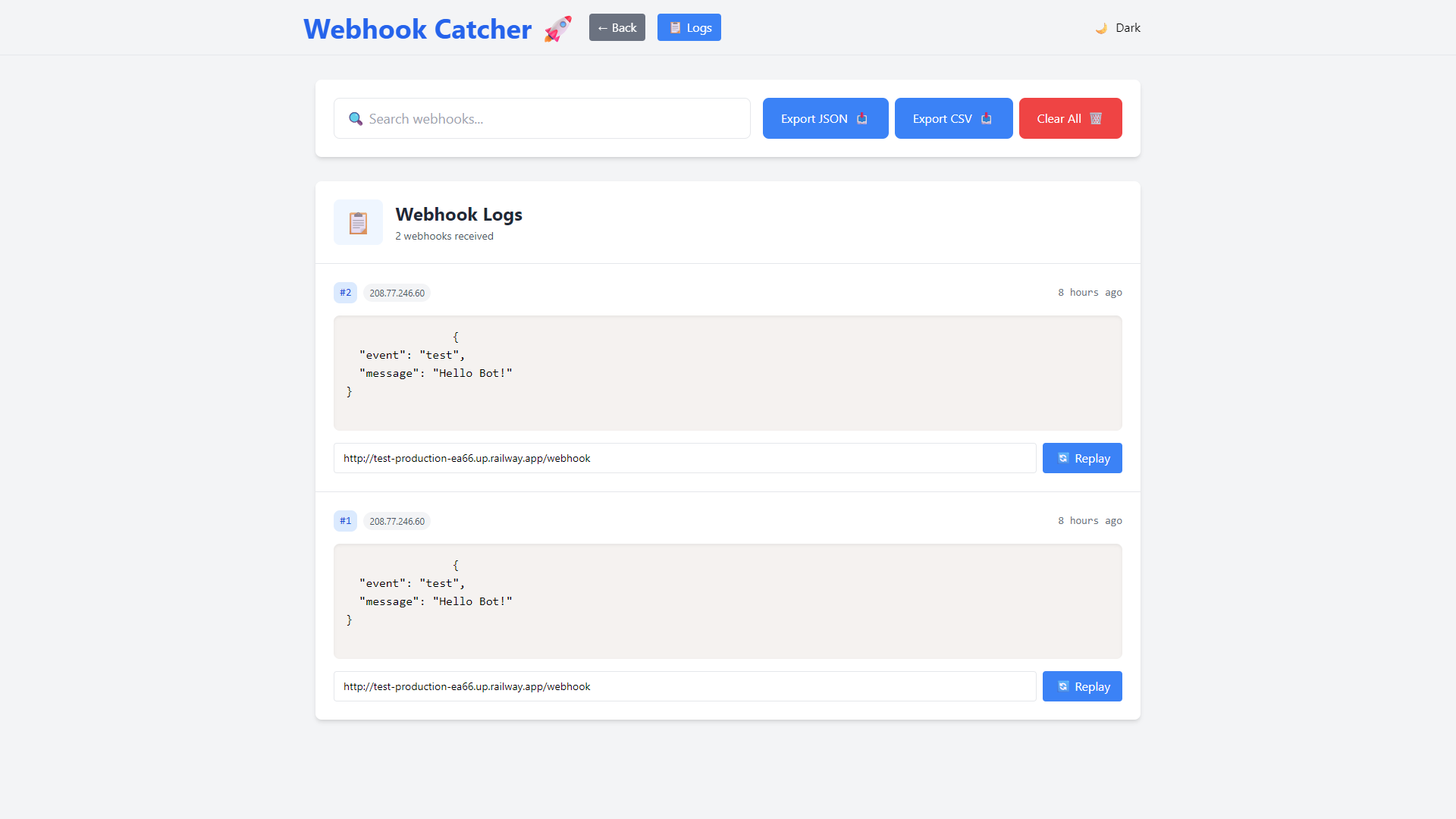
- Search, filter, and export webhook logs
- Replay webhooks to any target URL
- Multi-service ready: forward webhooks to your own bot/service
- Production-ready admin protection for sensitive operations
- Deploy instantly on Railway or any platform
🚀 Deploy on Railway (Recommended)
⚡ Why Railway?
Webhook Catcher is optimized for Railway:
- 🧠 Zero config — deploy in seconds
- 🪄 Auto-generated domain (instantly test your webhook)
- 💾 Automatic persistent storage (no data loss on redeploy)
- 🔐 Built-in secret management & protection
💾 Persistent Storage (Railway)
Webhook Catcher uses SQLite for storage.
When deploying via the Railway template, a persistent volume is automatically created and mounted — no manual setup required.
✔ Data persists across redeploys
✔ No configuration needed
✔ Works out of the box
✨ Sophisticated Architecture Overview
graph TB
    A[External Webhooks<br/>GitHub, Stripe, IoT] --> B[Load Balancer]
    B --> C[Webhook Catcher Service<br/>FastAPI + HTMX]
    C --> D[SQLite Database<br/>Persistent Volume]
    C --> E[Your Bot Service<br/>Python/Node/etc]
    E --> F[Discord/Slack/etc<br/>Notifications]
    C --> G[Real-time Web UI<br/>Live Updates]

    style C fill:#0ea5e9
    style E fill:#10b981
    style D fill:#f59e0b
🧩 Use Cases
- Debug Stripe or GitHub webhooks in production
- Build and test bots for Discord, Telegram, or Slack
- Capture IoT webhook payloads for later processing
- Replay webhooks to local dev or staging environments
Quick Start
-
Deploy on Railway:

-
Send a webhook:
Use your deployed/webhookendpoint with any service or tool (e.g., GitHub, Stripe, curl).curl -X POST https://your-app.railway.app/webhook \ -H "Content-Type: application/json" \ -d '{"event": "test", "message": "Hello"}' -
View and replay webhooks:
Open the web UI to see logs, search, export, or replay to another URL.
Screenshots
🔧 Configuration
Environment Variables
| Variable | Description | Required | Default |
|---|---|---|---|
FORWARD_WEBHOOK_URL |
Forward incoming webhooks to another service | No | - |
FORWARD_WEBHOOK_TOKEN |
Authentication token for secure forwarding | No | - |
ADMIN_TOKEN |
Admin protection token for sensitive operations | No | - |
FRONTEND_PASSWORD |
Password to protect the web UI from public access | No | - |
🔒 Admin Protection (Production Feature)
The ADMIN_TOKEN environment variable provides production-grade security for sensitive operations:
Protected Operations:
- Clear all logs (
POST /clear) - Replay webhooks (
POST /replay/{id})
Security Modes:
1. No Protection (Development)
# Leave ADMIN_TOKEN empty or unset
ADMIN_TOKEN=""
- All operations are publicly accessible
- Perfect for development and testing
2. Token Protection (Production)
# Set a strong admin token
ADMIN_TOKEN="your-secret-admin-token-123"
- Admin operations require authentication
- Token can be provided via:
- Header:
X-Admin-Token: your-secret-admin-token-123 - Query parameter:
?admin_token=your-secret-admin-token-123
- Header:
Usage Examples:
Clear logs with admin token:
# Via header (recommended)
curl -X POST "https://your-app.railway.app/clear" \
  -H "X-Admin-Token: your-secret-admin-token-123"

# Via query parameter
curl -X POST "https://your-app.railway.app/clear?admin_token=your-secret-admin-token-123"
Replay webhook with admin token:
curl -X POST "https://your-app.railway.app/replay/1?target_url=https://httpbin.org/post" \
  -H "X-Admin-Token: your-secret-admin-token-123"
Health check shows protection status:
curl https://your-app.railway.app/healthz
# Returns: {"status": "ok", "admin_protected": true}
Security Best Practices:
- Use a strong, random token (minimum 20 characters)
- Keep the token secret and rotate it regularly
- Use headers instead of query parameters when possible
- Enable admin protection for production deployments
🔐 Frontend Password Protection
The FRONTEND_PASSWORD environment variable protects the web UI from public access using HTTP Basic Authentication.
Protected Routes:
- Home page (
GET /) - Logs view (
GET /logs,GET /logs/view) - Export logs (
GET /export) - List webhooks (
GET /webhooks)
Unprotected Routes (remain open):
- Webhook receiver (
POST /webhook) - external services must be able to send webhooks - Health check (
GET /healthz) - Config status (
GET /config)
Usage:
1. No Protection (Development)
# Leave FRONTEND_PASSWORD empty or unset
FRONTEND_PASSWORD=""
- Web UI is publicly accessible
- Perfect for development and testing
2. Password Protection (Production)
# Set a password to protect the web UI
FRONTEND_PASSWORD="your-secret-password"
- Accessing the web UI prompts for HTTP Basic Auth
- Username can be anything (only password is checked)
- Browser remembers credentials for the session
How it works:
When FRONTEND_PASSWORD is set, accessing protected routes will prompt your browser's built-in HTTP Basic Auth dialog. Enter any username and the configured password to access the UI.
Advanced Features
Multi-Service Architecture
- Internal networking: Link your own service using
FORWARD_WEBHOOK_URL - Secure forwarding: Use
FORWARD_WEBHOOK_TOKENfor authenticated service-to-service communication - Real-time processing: Forward webhooks immediately while storing for replay
Data Persistence
- SQLite database with volume mounting
- Export capabilities: JSON and CSV formats
- Search functionality: Full-text search across webhook payloads
- Replay system: Resend any webhook to any URL
Modern UI/UX
- Real-time updates with HTMX and Server-Sent Events
- Dark/light mode with system preference detection
- Responsive design optimized for mobile and desktop
- Syntax highlighting for JSON payloads with Prism.js
Platform Features
This template is optimized for modern cloud platforms:
- ✅ One-click deployment with railway.json template
- ✅ Environment variable management for configuration
- ✅ Automatic persistent storage via Railway volumes
- ✅ Health checks for service monitoring
- ✅ Internal networking for multi-service communication
- ✅ Production security with admin token protection
- ✅ Modern web stack (FastAPI + HTMX + TailwindCSS)
- ✅ Cross-platform compatibility (Unix/Windows/PowerShell)
License
MIT License - Use freely for personal and commercial projects.